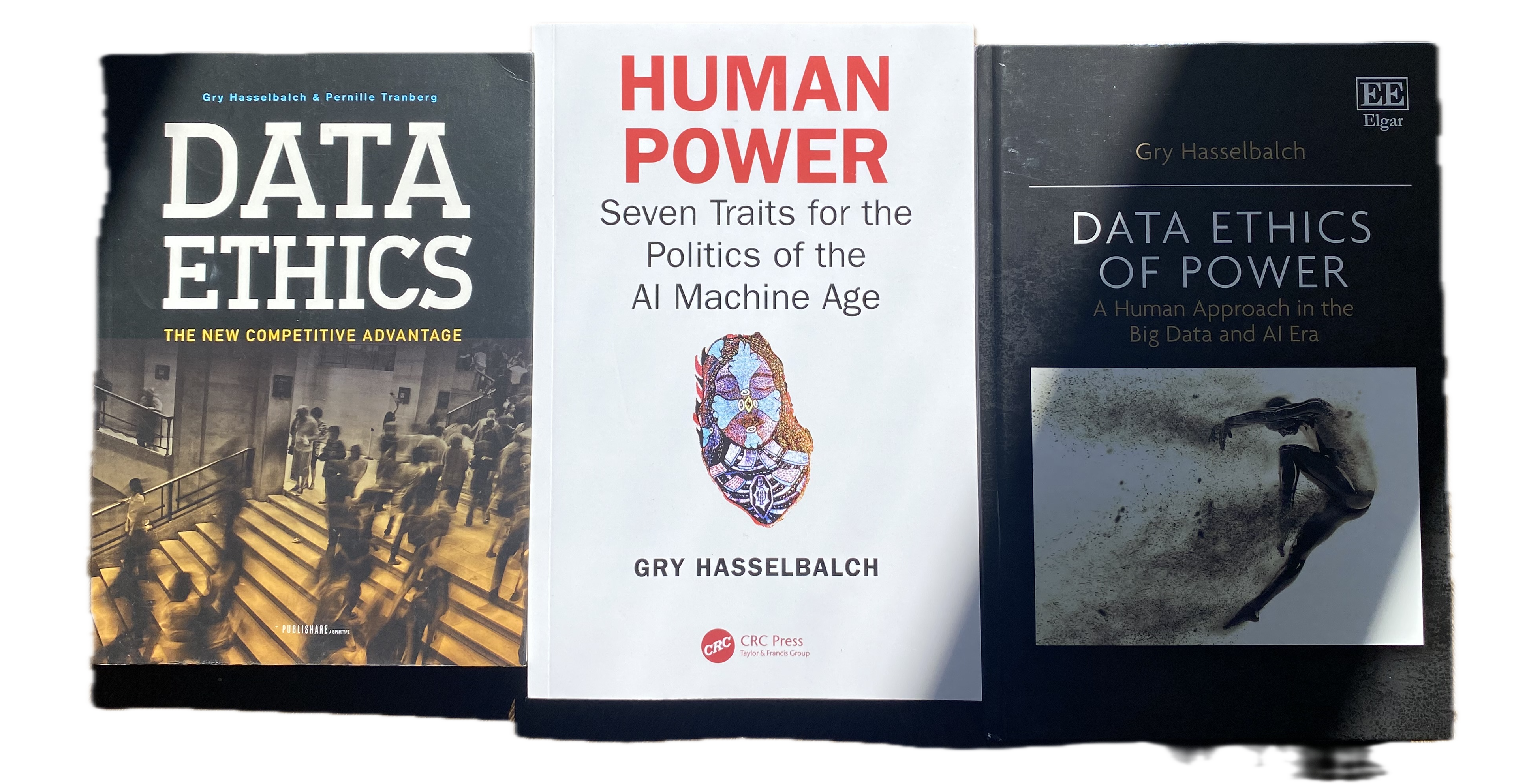
Gry Hasselbalch’s research focuses on data and AI infrastructures, analysing how power becomes visible, and human empowerment exposed, as socio-technical systems are negotiated.
Her research agenda is reflected in her last two academic monographs, Data Ethics of Power – A Human Approach in the Big Data and AI Era (Edward Elgar, 2021) and Human Power – Seven Traits for the Politics of the AI Machine Age (Taylor & Francis/CRC Press, 2025), which together form the conceptual spine of this agenda. In Data Ethics of Power, she traces the power dynamics, history and culture of the 21st-century big data and AI socio-technical infrastructures evolving in the EU and global context, identifying three competing layers: Big Data Socio-Technical Infrastructures of Power (BDSTIs), AI Socio-Technical Infrastructures of Power (AISTIs), and a third, socio-technical strand of human empowerment. In Human Power, she extends this argument into a theory of human power, repositioning the humanities with human agency and values at the center of a technology politics debate long dominated by tech-determinist narratives.
Hasselbalch’s research combines social science and cultural theory, science and technology studies (STS), and infrastructure studies with digital humanism and embedded, qualitative policy ethnography grounded in close engagement with policymakers, civil society, and industry.
She holds a PhD in data and AI ethics and power from the University of Copenhagen, is Academic Director of DataEthics.eu and Senior Research Associate at the African Centre for Epistemology and Philosophy of Science, University of Johannesburg. She has been leading academic research, such as the Data Pollution and Power research project at Bonn University and the EU’s International Outreach for a Human Centric Approach to AI initiative’s research and intelligence studies and activities.
Examples of research she is working on in 2026:
Leading the Nordic Council of Ministers project “Mapping, Exploration and Human-Centric Recommendations for Digital Tools and AI Use in the Work on Integrating Refugees and Migrants in the Nordic Capital Cities” studying how public authorities in the Nordic capitals use digital and AI tools in integration services for immigrants and refugees with a specific focus on the “human dimension” of digitalisation.
Algorithmic power and “humanness”: Drawing on Henri Bergson’s philosophy of intuition and Gilles Deleuze’s elaboration of it into a precise method she explores intuition as a mode of collective human resistance that complements human-centred AI approaches. The paper “Intuition as Method Against Algorithmic Power: Human Life at Work in the AI Machine Age” was submitted to New Media and Society in September 2026.
List of Publications
Academic talks and panels